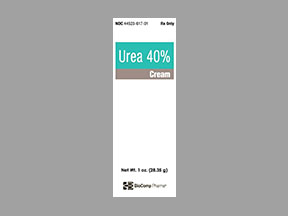
Urea
Urea 28.35GM of 40%
What is Urea?
Urea, also known as carbamide, is an organic compound with the chemical formula (NH2)2CO. It is used in pharmaceutical preparations as a keratolytic agent, helping to hydrate and exfoliate the skin by increasing moisture content and breaking down hard skin cells. Urea is widely incorporated into topical creams, ointments, and lotions to treat dry, rough, and scaly skin conditions such as eczema, psoriasis, and ichthyosis.Side Effects
- Local irritation (redness, itching, burning sensation)
- Skin rash
Warnings
- Avoid contact with eyes, lips, or mucous membranes
- Not recommended for use on broken or severely irritated skin
Prescription savings · · · ·
What is Urea ?
Urea, also known as carbamide, is an organic compound with the chemical formula (NH2)2CO. It is used in pharmaceutical preparations as a keratolytic agent, helping to hydrate and exfoliate the skin by increasing moisture content and breaking down hard skin cells. Urea is widely incorporated into topical creams, ointments, and lotions to treat dry, rough, and scaly skin conditions such as eczema, psoriasis, and ichthyosis.- Local irritation (redness, itching, burning sensation)
- Skin rash
- Avoid contact with eyes, lips, or mucous membranes
- Not recommended for use on broken or severely irritated skin
Urea Coupons & Prices
Urea 28.35GM of 40%

Weight-loss medication, prescribed online
Licensed U.S. providers · No insurance needed · Shipped to your door
Urea prices by dosage
Lowest cash price with a free Rx.com coupon vs. the average retail price.
| Dosage | Quantity | Retail price | Rx.com price |
|---|---|---|---|
| 1gm of · Bottle | 1 | — | $3.94 |
| 28gm of 40% · Bottle | 28 | $88.99 | $12.15 |
| 28.35gm of 40% · Bottle | 28.35 | $105.99 | $84.54 |
| 85gm of 40% · Bottle | 85 | $133.99 | $116.54 |
| 85gm of 20% · Bottle | 85 | $15.99 | $11.35 |
| 100gm of · Bottle | 100 | $41.99 | $30.59 |
| 198gm of 40% · Bottle | 198 | $25.99 | $22.34 |
| 198.4gm of 40% · Bottle | 198.4 | $142.99 | $122.65 |
Cash prices near ZIP 77433; updated regularly. Actual pharmacy price may vary.
Looking for a urea coupon? Urea is a widely available generic topical medication, sold under brand names like Utopic, Umecta, Keralac, Carmol, and Nutraplus, and because it is generic it is already one of the more affordable skin treatments. Even so, the cash price can vary a lot from one pharmacy to the next, so it pays to compare. Rx.com checks prices across more than 60,000 pharmacies so you can find a low price near you. Enter your ZIP above to see today's price on urea and print or show your free coupon at the pharmacy counter.
What is urea and how does it work?
Urea (topical) is a keratolytic emollient, which means it works two ways at once: it draws and holds moisture in the skin (a humectant) and helps soften and break down thick, hardened, or scaly skin. It is used to moisturize and smooth dry, rough, thick, or scaly skin. Lower strengths of 10 to 20 percent are commonly sold over the counter as everyday moisturizers, while higher prescription strengths (for example 40 to 50 percent) are used to help remove and heal very thick, hardened surface lesions, including where healing is slowed by local infection, dead tissue, or crusting.
It is often used, both on-label and off-label, for hyperkeratotic and very dry (xerotic) skin conditions such as xerosis, ichthyosis, keratosis pilaris, corns, calluses, dermatitis, eczema, and psoriasis, as well as for thickened, damaged, or ingrown nails. This is general information, not medical advice; your provider or pharmacist can help you choose the right strength for your situation.
Urea cost without insurance and how to save
Because urea is available as a generic, it is already a lower-cost option compared with many brand-name skin treatments. The catch is that the cash price without insurance is not the same everywhere. Different pharmacies set different prices for the same strength and tube size, so two stores in the same town can charge very different amounts. That is exactly why comparing before you fill matters.
Rx.com compares urea prices across more than 60,000 pharmacies and shows you a free coupon you can use with or without insurance. There is no manufacturer savings card for generic urea, so a pharmacy-price coupon is usually the most practical way to keep the cost down. Enter your ZIP above to see today's price near you, then bring the coupon to the counter.
Urea alternatives and related treatments
Urea is one of several topical options for dry, thick, or scaly skin, and the right choice depends on your skin and your provider's guidance. Other keratolytic or moisturizing treatments people compare with urea include salicylic acid, ammonium lactate, and lactic acid. For certain conditions, providers may instead prescribe tretinoin or, for plaque psoriasis, calcipotriene.
These medicines work in different ways and are not interchangeable, so talk with your provider or pharmacist about which fits your needs. Whichever one you and your provider choose, you can check and compare its price on Rx.com.
Urea safety and side effects
Urea is for external, topical use only. Avoid getting it in your eyes, on your lips, or on other mucous membranes. The most common effects are local and usually temporary, including stinging, burning, itching, redness, or irritation, and these are more likely on broken or inflamed skin. Do not apply it to open wounds beyond its intended debridement use unless your provider directs you to. There is no boxed warning for topical urea.
Rarely, an allergic reaction can occur. Stop using it and seek medical care if you notice a rash, hives, swelling of the face, lips, or tongue, or trouble breathing. This is general information and not a substitute for medical advice, so follow the product instructions and check with your provider or pharmacist with any questions.
This Urea information was written and reviewed against authoritative U.S. medical sources — MedlinePlus (U.S. National Library of Medicine), DailyMed, and FDA prescribing information — and checked for accuracy. It is provided for education and is not a substitute for professional medical advice.
Verify the official label: Urea on DailyMed (FDA)
Reviewed against FDA labeling · Last reviewed July 2026
Related Drugs
Browse more medications: starting with U · full A-Z directory · by condition · common drugs
Medical disclaimer: This information is provided for general educational purposes only and is not medical advice. It is not a substitute for professional diagnosis or treatment. Always consult a licensed physician, pharmacist, or other qualified healthcare provider before starting, stopping, or changing any medication or treatment. Never disregard professional medical advice or delay seeking it because of something you read here. If you think you may have a medical emergency, call your doctor or 911 immediately.


