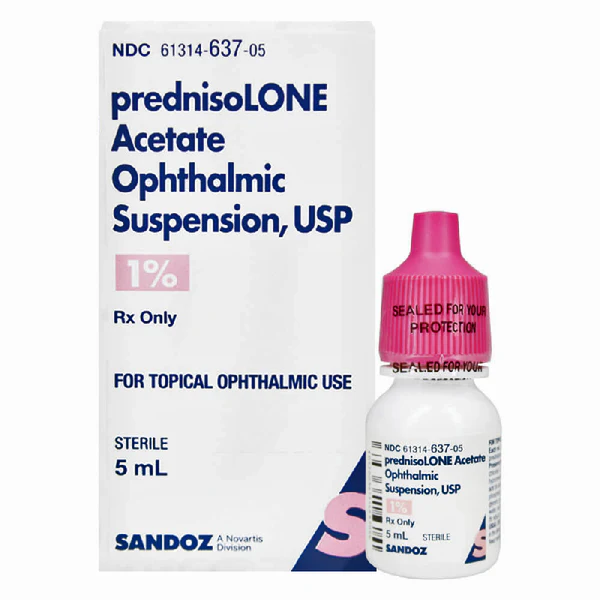
Prednisolone Acetate
prednisoLONE Acetate 5ML of 1%
What is Prednisolone Acetate?
Prednisolone Acetate is a generic medication used to treat swelling of the eyes. The average price of Prednisolone Acetate is around $118 for a supply of 25 ml of 20 mg ophthalmic solution. Use our Rx.com savings offer to get great discounts on Prednisolone Acetate at participating pharmacies near you.
Side Effects
- Blurred vision, changes in vision
- Changes in skin color, dark freckles
- Increased pain, redness, discharge, swelling, or irritation of the eye
Warnings
- Keep all medicine out of the reach of children. Never share your medicine with anyone.
- Do not stop using this medicine suddenly. Your doctor will need to slowly decrease your dose before you stop it completely.
- Ophthalmic routeIf you hurt your eye, develop an eye infection, or need to have eye surgery, talk with your doctor right away. You may need to change your medicine or stop using it. Tell your doctor if you had a cataract surgery.
- This medicine may cause the following problems:Eye problems (including glaucoma, cataracts, infections) with long-term useIncreased pressure in your eyeSlow healing of the eye
- Tell your doctor if you are pregnant or breastfeeding, or if you have glaucoma or a history of herpes infection.
Prescription savings · · · ·
What is Prednisolone Acetate ?
Prednisolone Acetate is a generic medication used to treat swelling of the eyes. The average price of Prednisolone Acetate is around $118 for a supply of 25 ml of 20 mg ophthalmic solution. Use our Rx.com savings offer to get great discounts on Prednisolone Acetate at participating pharmacies near you.
- Blurred vision, changes in vision
- Changes in skin color, dark freckles
- Increased pain, redness, discharge, swelling, or irritation of the eye
- Cold feeling, weakness, tiredness, nausea, vomiting, weight loss
- Allergic reaction: Itching or hives, swelling in your face or hands, swelling or tingling in your mouth or throat, chest tightness, trouble breathing
- Weight gain around your neck, upper back, breast, face, or waist
- Keep all medicine out of the reach of children. Never share your medicine with anyone.
- Do not stop using this medicine suddenly. Your doctor will need to slowly decrease your dose before you stop it completely.
- Ophthalmic routeIf you hurt your eye, develop an eye infection, or need to have eye surgery, talk with your doctor right away. You may need to change your medicine or stop using it. Tell your doctor if you had a cataract surgery.
- This medicine may cause the following problems:Eye problems (including glaucoma, cataracts, infections) with long-term useIncreased pressure in your eyeSlow healing of the eye
- Tell your doctor if you are pregnant or breastfeeding, or if you have glaucoma or a history of herpes infection.
- Call your doctor if your symptoms do not improve or if they get worse.
- Your doctor will check your progress and the effects of this medicine at regular visits. Keep all appointments.
Prednisolone Acetate Coupons & Prices
prednisoLONE Acetate 5ML of 1%
Weight-loss medication, prescribed online
Licensed U.S. providers · No insurance needed · Shipped to your door
Prednisolone Acetate prices by dosage
Lowest cash price with a free Rx.com coupon vs. the average retail price.
| Dosage | Quantity | Retail price | Rx.com price |
|---|---|---|---|
| 5ml of 1% ophth susp (eye) · Bottle | 5 | $44.25 | $19.34 |
| 5ml of 1% · Bottle | 5 | $57.69 | $18.71 |
| 10ml of 1% ophth susp (eye) · Bottle | 5 | $64.69 | $19.33 |
| 10ml of 1% · Bottle | 5 | $63.99 | $18.71 |
| 10gm of powder · Bottle | 14 | — | $850.16 |
| 15ml of 1% ophth susp (eye) · Bottle | 15 | $89.49 | $45.42 |
| 15ml of 1% · Bottle | 15 | $170.99 | $45.11 |
| 25gm of powder · Bottle | 5 | — | $306.84 |
Cash prices near ZIP 77433; updated regularly. Actual pharmacy price may vary.
Looking for a prednisolone acetate coupon? Prednisolone acetate ophthalmic is the low-cost generic version of brand-name steroid eye drops like Pred Forte, Pred Mild, Omnipred, and Econopred Plus. Because it is already available as a generic, cash prices are often modest, but they still vary widely from one pharmacy to the next, so comparing before you fill can make a real difference. Enter your ZIP above to see today's price at pharmacies near you. Rx.com compares prices across more than 60,000 pharmacies so you can find the best cash price without insurance.
What is prednisolone acetate and how does it work?
Prednisolone acetate is a corticosteroid (glucocorticoid) eye drop used to treat steroid-responsive inflammation of the eye. As an anti-inflammatory suspension, it calms swelling, redness, and irritation affecting the conjunctiva, cornea, and the front (anterior) portion of the eye. It is FDA-approved for conditions such as allergic conjunctivitis, acne rosacea affecting the eye, superficial punctate keratitis, herpes zoster keratitis, iritis, cyclitis, selected infective conjunctivitides, and inflammation caused by corneal injury from chemical, radiation, or thermal burns or a foreign body. Doctors also very commonly prescribe it for inflammation after eye surgery, such as cataract surgery, and for uveitis flares.
It comes as a suspension in two strengths: 1% (sold as Pred Forte and Omnipred) and 0.12% (sold as Pred Mild). Because it is a suspension rather than a solution, the medicine settles over time and must be shaken well before every use so you get an even dose. This is a summary and not medical advice; your eye doctor will choose the strength and schedule that fits your condition.
Prednisolone acetate cost and savings without insurance
Prednisolone acetate is available as a generic, which generally keeps the cash price lower than the brand-name versions like Pred Forte. Even so, what you pay out of pocket can differ significantly depending on which pharmacy you use, the bottle size, and the strength (1% versus 0.12%). That price spread is exactly why comparing pharmacies matters, even for an inexpensive generic.
Rx.com compares prednisolone acetate prices across more than 60,000 U.S. pharmacies so you can find the lowest cash price near you, with or without insurance. Prices change often and are shown live, so enter your ZIP code above to see today's price and the free coupon you can bring to the pharmacy counter.
Prednisolone acetate vs. other steroid eye drops
Prednisolone acetate is one of several corticosteroid eye drops your doctor might consider. Related options include prednisolone in its other ophthalmic forms, along with dexamethasone, loteprednol, fluorometholone, and difluprednate. These drops differ in potency, how likely they are to raise eye pressure, and the conditions they are typically used for.
If your prescription is written for a brand, you can also compare it to the generic. The brand Pred Forte and generic prednisolone acetate 1% contain the same active ingredient. Ask your prescriber or pharmacist whether a generic or an alternative steroid is appropriate for you, then compare cash prices here to find the best value.
Safety and important warnings
Prednisolone acetate has no boxed warning, but steroids used in the eye carry real risks, especially with prolonged use. Long-term use can raise pressure inside the eye (which can lead to glaucoma and optic nerve damage), cause posterior subcapsular cataracts, and slow wound healing. Because steroids can mask or worsen an eye infection, they may allow secondary bacterial, viral, or fungal infections to develop, and prolonged use has been linked to thinning of the cornea or sclera and, rarely, perforation. For these reasons, your doctor may check your eye pressure if you use it beyond about 10 days.
This medicine should not be used in most viral corneal or conjunctival diseases, including epithelial (dendritic) herpes simplex keratitis, vaccinia, and varicella, or in mycobacterial or fungal eye infections. The suspension contains sodium bisulfite, which can cause allergic-type or, rarely, anaphylactic reactions in sensitive people. Shake well before use, and never inject it. This is general information, not medical advice; use it exactly as prescribed and contact your eye doctor if you have pain, worsening vision, or new symptoms.
This Prednisolone Acetate information was written and reviewed against authoritative U.S. medical sources — MedlinePlus (U.S. National Library of Medicine), DailyMed, and FDA prescribing information — and checked for accuracy. It is provided for education and is not a substitute for professional medical advice.
Verify the official label: Prednisolone Acetate on DailyMed (FDA)
Reviewed against FDA labeling · Last reviewed July 2026
Related Drugs
Browse more medications: starting with P · full A-Z directory · by condition · common drugs
Medical disclaimer: This information is provided for general educational purposes only and is not medical advice. It is not a substitute for professional diagnosis or treatment. Always consult a licensed physician, pharmacist, or other qualified healthcare provider before starting, stopping, or changing any medication or treatment. Never disregard professional medical advice or delay seeking it because of something you read here. If you think you may have a medical emergency, call your doctor or 911 immediately.


